☀ Floating solar power plant: generation extends beyond the land.
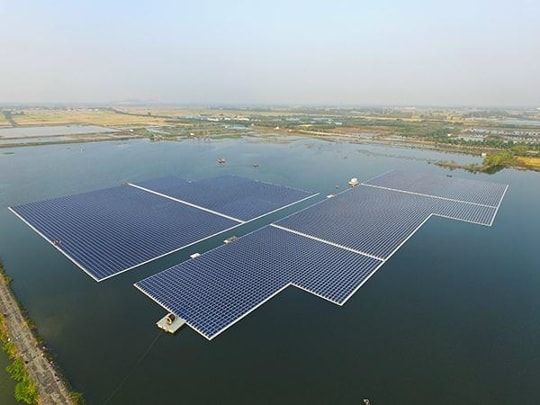
One noteworthy example of modern energy engineering can be found in China’s Anhui Province, near the city of Huainan. A 150 MW floating solar photovoltaic power plant has been constructed there on a body of water formed in an area of land subsidence caused by coal mining.
This represents an interesting engineering case: an area historically associated with the coal industry has acquired a new function in the energy sector.
⚡ Construction of the power plant began in 2017. The first phase was connected to the grid in December of the same year, and the project was fully completed in 2018.
🔌 The floating configuration offers several advantages. Such a power plant does not occupy valuable land resources, while the surrounding water helps reduce the operating temperature of the photovoltaic modules. This is particularly important because the efficiency of photovoltaic modules generally decreases as their temperature increases.
🌊 At the same time, this type of solution presents a number of engineering challenges. The floating platforms must withstand wind loads, wave action, fluctuations in water level, and corrosive environmental conditions, while ensuring the safe operation of the equipment and reliable delivery of generated electricity to the grid.
💡 This is precisely what makes the project particularly interesting: it demonstrates that the development of modern energy systems is driven not only by new sources of power generation, but also by innovative engineering approaches. In some cases, a power plant can emerge in a location once associated with coal extraction, where solar panels now generate electricity on the surface of the water.